

- This event has passed.
Camden Philosophical Society: “The Perpetual War” and Roberto Calasso
Tuesday, March 17 @ 3:30 pm – 5:30 pm
The March 17th session of the Camden Philosophical Society will, as usual, be a hybrid gathering from 3:30-5:30 pm EDT on the third Tuesday of the month. All are welcome to participate, in-person at the Picker Room of the Camden Public Library or by Zoom. That goes for visitors, as well as year-rounders in Maine, and friends of the society wherever you may be.
If you wish to join via Zoom, please email sewright772@gmail.com. You will receive a Zoom invitation on the day of the meeting. Click on the “Join Zoom Meeting” link in that invitation at the time of the event.
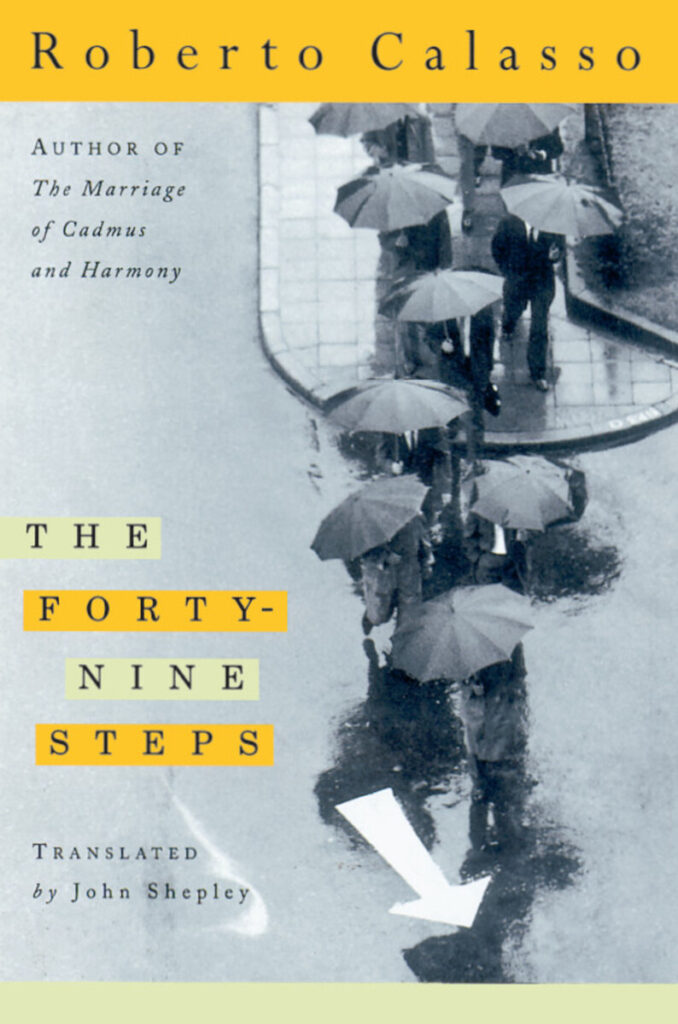
The discussion this month, led by Peter Aldrich, will take a somewhat unorthodox and idiomatic approach towards philosophical dialogue. The subject material will be an essay called “The Perpetual War” written by the Italian polymath, author, critic, and editor Roberto Calasso. It is one of the numerous essays in his 1991 collection called The Forty Nine Steps.
Our discussion will focus on pages 91-108 “The Perpetual War” found here.
Peter provides this introduction:
“The Perpetual War” is a provocative, enthusiastic, and deeply respectful appreciation of early 20th century journalist, author, and performance artist Karl Klaus. The essay examines Klaus’ more than 700 weekly satirical performances between the years 1896-1934 and the direct connection and overlap with his most acclaimed drama “The Last Days Of Mankind.”
Klaus was three times nominated for the Nobel prize. For years his weekly performances were sold out. Philosopher Ludwig Wittgenstein, a fellow Austrian, is said to have never missed a performance and in a 1931 published article acknowledged Klaus, along with a number of famous philosophers, logicians and mathematicians, as a strong influence on clarifying his own work. Klaus additionally, was a brilliant and witty aphorist, as evidenced in his query: How is the world ruled and led to war? Diplomats lie to journalists and believe these lies when they see them in print.
Calasso clearly recognizes Klaus’ prodigious prophetic ability to accurately discern the moral and political zeitgeist that underpinned Austrian culture in his time. What was he seeing and thinking about that the rest of Vienna and Europe wasn’t paying attention to or thinking about in the years preceding and during WWI?
How did Klaus arrive at his epiphanies? What was his method or process and how similar was it to Socrates’? Like Socrates in the first sentence of Plato’s “Republic, Klaus ventures down to Piraeus, the port city of Athens, only it is Vienna and the year is around 1910. Perhaps, also, we can draw a straight line to Hannah Arendt’s “Eichmann In Jerusalem” in which she proposes Eichmann’s real evil was his inability to think for himself, and that like the citizens in Klaus’ Vienna 1910, he had contentedly and lazily given a “fully mechanized and mobilized” institution the power to do his thinking and governing for him. Not, perhaps, unlike what Thomas Hobbs proposed in “Leviathan.”