

- This event has passed.
Camden Philosophical Society: “In Praise of Idleness and Other Essays” by Bertrand Russell
Tuesday, September 16, 2025 @ 3:30 pm – 5:30 pm
With summer almost gone, the Camden Philosophical Society is taking an early autumnal detour at its Tuesday, Sep. 16, gathering to discuss a selection of readings from In Praise of Idleness and Other Essays by the evidently rarely idle 20th century British philosopher and mathematician Bertrand Russell. His views were often outspoken, impassioned, and controversial, but a century later, many of them are still worth reading for their eloquence, wit and provocation. A full copy of the book can be found here: https://ia801702.us.archive.org/8/items/in.ernet.dli.2015.458601/2015.458601.In-Praise-Of-Idleness-And-Other-Essays_text.pdf
The Sep. 16 session will, as usual, be a hybrid gathering from 3:30-5:30 pm EDT on the third Tuesday of the month. All are welcome to participate, in-person at the Picker Room of the Camden Public Library or by Zoom. That goes for visitors, as well as year-rounders in Maine, and friends of the society wherever you may be.
If you wish to participate via Zoom, please email sarahmiller@usa.net. You will receive a Zoom invitation on the morning of the meeting. Click on the “Join Zoom Meeting” link in that invitation at the time of the event.
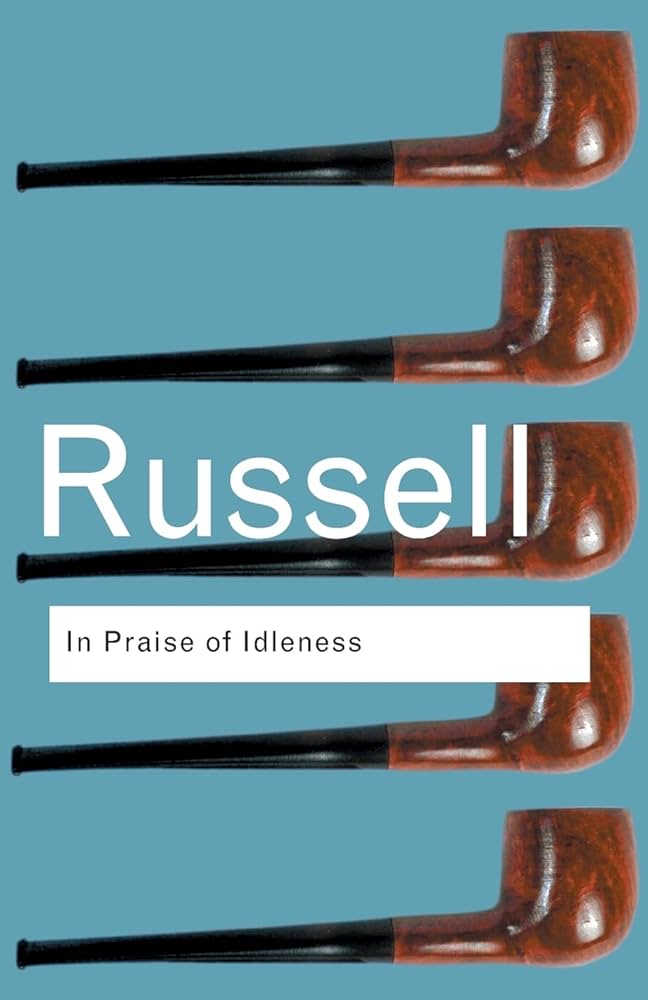
The three essays we’ll be reading — chapters I (In Praise of Idleness), II (“Useless” Knowledge), and XI (Of Men and Insects) — provide a quick introduction to Russell’s humanistic social and political worldview.
In chapter I, Russell takes on one of Western culture’s most sacred cows: work. In his view, work is required in so far as it can provide the necessities of life for everyone. Beyond that it becomes an instrument of power and slavery. With that in mind, Russell welcomed such things as technological advances that could reduce the amount of time needed to produce those necessities of life and increase the amount of leisure for everyone. Leisure, for Russell, is the mark of civilization. With it, a person can create enjoyment or innovate as one sees fit.
In the second chapter, he meditates on one of the leisure pursuits: learning for the sake of learning, exploring “useless” avenues and byways of human history, culture, or experience. For Russell, this kind of learning is a good in itself that can bring joy and make life worth living. It can help one to develop a more humane approach to life. He does not disregard “useful” technical knowledge, but he does argue that “useless” knowledge can help to develop perspective, moderation, judgement, and purpose.
In the final selected chapter (XI), Russell reflects on humanity’s hubris. Does our preoccupation with domination cloud our ability to understand the ramifications of that dominance? Do we take the time to consider the consequences? It’s a very short chapter, but thought provoking all the same.
Some Bertrand Russell tidbits:
In addition to being recognized as a mathematician, a logician, a coauthor of Principia Mathematica with A. N. Whitehead, a cofounder of Analytic Philosophy with G. E. Moore, mentor to Ludwig Wittgenstein, a Nobel Prize recipient (Literature 1950), a committed anti-war activist, and the driving force behind the “Russell-Einstein Manifesto,” written in an effort to ban the use of weapons of mass destruction, Russell was a public intellectual involved in contemporary social issues of the day. He was imprisoned several times for his anti-war activities, while ultimately receiving the Order of Merit from King George VI in 1949. He was an earl, a politician, a social commentator, an atheist, a socialist, and a lecturer at Trinity College, Cambridge; Harvard; London School of Economics, Johns Hopkins; Bryn Mawr, etc. His godfather was John Stuart Mill. He met with Lenin in the USSR and left the meeting underwhelmed. He attempted to mediate a de escalation between Khrushchev and Kennedy during the Cuban Missile Crisis. He started the Russell Vietnam War Crimes Tribunal along with Jean Paul Sartre and others….
For more information about Bertrand Russell: https://plato.stanford.edu/entries/russell/