

- This event has passed.
Camden Philosophical Society: David Hume & Artificial Intelligence
Tuesday, October 21, 2025 @ 3:30 pm – 5:30 pm
At its next gathering, on Tuesday, Oct. 21, the Camden Philosophical Society will discuss ideas put forward by 18th Century empirical philosopher David Hume — and ways in which those ideas remain relevant to today’s world of intense dispute over what constitutes truth. We’ll also consider how Hume’s thinking may relate to artificial intelligence (AI), a topic of discussion by the Society earlier this year.
The October 21 session will, as usual, be a hybrid gathering from 3:30-5:30 pm EDT on the third Tuesday of the month. All are welcome to participate, in-person at the Picker Room of the Camden Public Library or by Zoom. That goes for visitors, as well as year-rounders in Maine, and friends of the society wherever you may be.
If you wish to participate via Zoom, please email saramiller@usa.net. You will receive a Zoom invitation on the day of the meeting. Click on the “Join Zoom Meeting” link in that invitation at the time of the event.
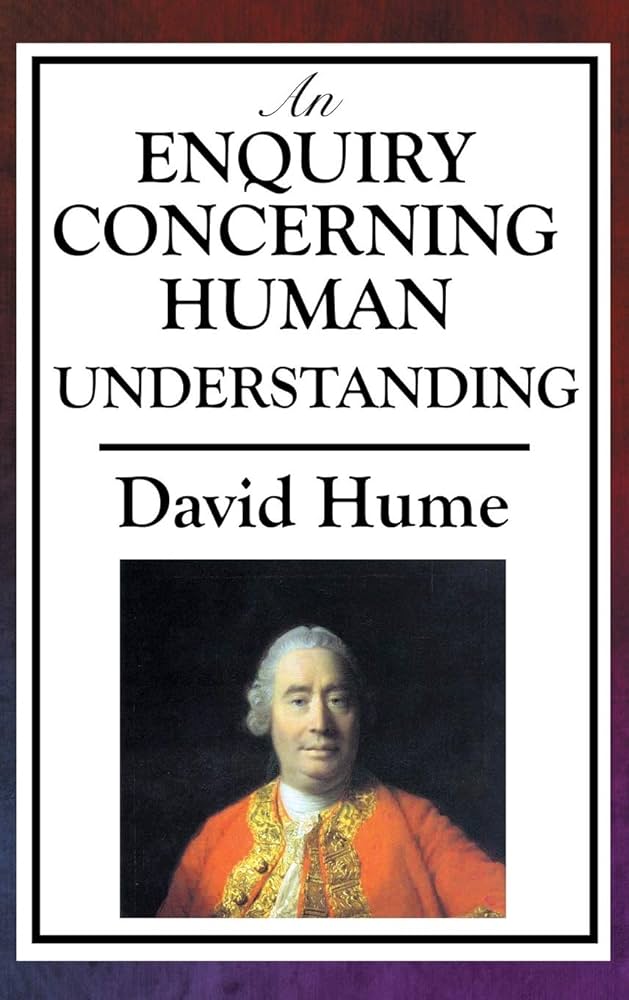
Best known in his lifetime for his History of England, Hume is now associated with philosophical skepticism, empiricism and, as stated clearly only in writings published after his death, atheism. He maintained that all “matters of fact” come to be known by humans through their “experience” of the physical world. Only pure mathematics and other conceptual forms of knowledge based exclusively on “relations of ideas” can be known “a priori” by humans, through reasoning alone.
Skeptical of any human capacity to know cause and effect with certainty, Hume argued instead that beliefs and less firm convictions about the way the world works are based on assessments of probability. Hume saw this empirical nature of human learning as directly comparable to the way in which non-human animals learn about and function in the world.
Hume’s empirical approach to human acquisition of knowledge, as opposed to the “pure reason” espoused by Emanuel Kant and others around that time, is seen by some thinkers today as providing parallels with AI, which learns from absorbing large bodies of often contradictory data. Contemporary philosopher and cognitive scientist Daniel Dennett, who spent his latter years in Down East Maine, has been compared to Hume in this regard, Dennett having been an avowed admirer of Hume’s thought.
Our readings for the Oct. 21 discussion start with selected portions of Hume’s An Enquiry Concerning Human Understanding, now his best-known mature work. The Oxford World’s Classics version of Hume’s Enquiry can be found here, for reading online or for download: https://fitelson.org/confirmation/hume_enquiry.pdf The paragraph numbers below apply to this version, and may or may not work with other versions.
Start with the first 1.5 pages of the Introduction. Then as follows:
* Section II (2) (Of the Origin of Ideas), paragraphs 1-7 and also 9. Covers his basic concept of the difference between sensory experience (sensations) and ideas, and his notion that ideas come only from sensory experience. (roughly 3 pages)
* Section IV (4) (Skeptical Doubts Concerning the Operations of the Understanding), Part 1, paras 4-12. (5 pages). Also, Section IV, Part 2, paras 20 and 23) (1 page each) Assumptions about cause and effect as regards matters of fact are based entirely on experience, not a priori reasoning.
* Section V (5) (Skeptical Solution of These Doubts), Parts 1 and 2, paras 1-14. How “custom or habit” forms a sense of knowledge. (7 pages)
* Section VI (6)-Entire section. The operation of probability in determining belief. (2 pages) .
*Section IX (9) (Of the Reason of Animals) Paras 1-2. On how animals learn from experience just as humans do. (1 page)
*Section XII (12) Paras 1-4 and 21-23 (Definition and defense of skepticism, and critique of radical skepticism). (2 pages)
Then read this discussion of Hume and Dennett in the context of AI. https://www.toolify.ai/ai-news/unveiling-the-connection-between-david-hume-and-ai-how-their-ideas-shape-the-future-1364243 Or those who prefer videos can try this on the same topic: https://www.yeschat.ai/blog-Did-David-Hume-Predict-the-Rise-of-Artificial-Intelligence-Find-Out-How-His-Ideas-Connect-to-Dani-10345
Some further, optional readings that may be of interest are:
Hume’s “Wisdom in the Age of AI.” https://www.econlib.org/david-humes-wisdom-in-the-age-of-ai-from-18th-century-probability-to-modern-uncertainty/
A book of essays on Hume and Contemporary Philosophy https://www.cambridgescholars.com/resources/pdfs/978-1-4438-4131-3-sample.pdf
Hume’s Treatise of Human Nature, a precursor to the Enquiry on Human Understanding (See above). The treatise goes harder on skepticism and is said to include his thinking on the transient nature of the self https://eclass.uoa.gr/modules/document/file.php/PHS414/David%20Hume_%20A%20Treatise%20of%20Human%20Nature_%20Volume%201_%20Texts.pdf
Those interested in pursuing further Hume’s division of knowledge into “relations of ideas” — that is mathematics and other “concepts and truths that are known purely through reason” – and “matters of fact” that “rely on sensory experience and empirical evidence” might want to check this out: https://philosophy.institute/western-philosophy/humes-empirical-framework-fact-vs-ideas/
An overview of Hume’s thinking: https://medium.com/@adolfoguinart/david-hume-enlightenment-thinker-and-architect-of-modern-thought-5be2bd7d8c1b